
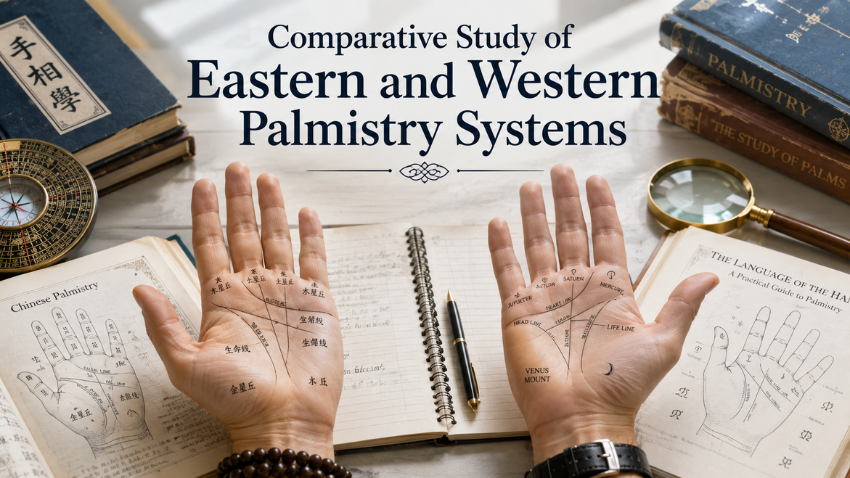
Palmistry is the practice of interpreting the features of the hand to gain insights into an individual’s personality, abilities, and life journey. For centuries, people from different cultures have used palmistry as a tool for self-discovery and guidance. Among the various traditions of hand reading, Eastern Palmistry and Western Palmistry are the two most influential systems. Although both focus on studying the hands, they differ in their history, philosophy, and methods of interpretation.
Understanding the Origins
Eastern Palmistry has its foundations in ancient Indian and Chinese traditions. In India, it developed alongside Vedic knowledge and was often linked with astrology, spirituality, and karma. Ancient scholars believed that the hands reflected not only a person’s character but also the effects of past actions and future possibilities.
Western Palmistry evolved through the contributions of ancient Greek, Egyptian, and Roman civilizations. As it spread across Europe, the practice became more focused on observing human behavior and understanding personality traits. This shift gave Western Palmistry a more practical and psychological approach.
Differences in Philosophy
The most noticeable distinction between Eastern and Western Palmistry is their underlying philosophy.
Eastern Palmistry considers the hand a symbolic map that highlights life purpose, karmic influences, and spiritual progress. Practitioners believe that life events and experiences are connected to deeper cosmic and spiritual forces. Therefore, readings often focus on life purpose, lessons, and long-term personal evolution.
Western Palmistry generally emphasizes individual character and personal development. Instead of concentrating heavily on destiny, it aims to help people understand their strengths, weaknesses, emotional patterns, and decision-making styles.
Approach to Hand Shapes
Both systems study the shape of the hand, but their classifications differ.
In Eastern Palmistry, hand shapes are often associated with planetary energies and traditional astrological concepts. Each shape is believed to reveal unique tendencies, talents, and life directions.
Western Palmistry commonly uses the four-element model: Earth, Air, Fire, and Water. Earth hands are associated with practicality, Air hands with intellect, Fire hands with enthusiasm, and Water hands with sensitivity. This method makes it easier for beginners to understand the basics of hand analysis.
Interpretation of Major Lines
The major lines of the palm are important in both traditions. These include the Life Line, Head Line, Heart Line, and Fate Line.
Eastern Palmistry studies these lines in connection with planetary mounts, finger formations, and astrological influences. The goal is to identify patterns that may reveal significant life experiences, opportunities, and challenges.
Western Palmistry focuses more on the psychological meaning of the lines. For example, the Head Line may be examined to understand thinking patterns, while the Heart Line may provide insight into emotional expression and relationships.
The Importance of Astrology
Astrology plays a significant role in Eastern Palmistry. The mounts located beneath the fingers are linked to different planets, and their development is carefully analyzed. Many practitioners combine palmistry with astrological principles to create a more detailed interpretation.
Western Palmistry acknowledges planetary symbolism but generally relies more on direct observation. Greater importance is placed on visible hand features rather than extensive astrological calculations.
Predictive and Practical Perspectives
Another major difference lies in the purpose of a reading.
Eastern Palmistry often includes predictive elements. Practitioners may discuss future possibilities, karmic influences, and important phases of life. The focus is on understanding how past actions and present choices shape future outcomes.
Western Palmistry is typically more practical and developmental. Rather than predicting specific events, it encourages self-awareness and personal growth. Readers often use it as a tool for understanding behavior, relationships, and career potential.
Similarities Between the Two Systems
Despite their differences, Eastern and Western Palmistry share several common principles:
- Both analyze hand shapes, lines, fingers, and mounts.
- Both believe that the hands reflect aspects of personality and life experiences.
- Both recognize that the features of the hand can change over time.
- Both aim to provide guidance and deeper self-understanding.
Conclusion
Eastern and Western Palmistry offer two valuable perspectives on the study of the human hand. Eastern Palmistry emphasizes spirituality, karma, astrology, and destiny, while Western Palmistry focuses on personality, psychology, and self-improvement. Together, these traditions provide a comprehensive understanding of palmistry and its role in personal development.
Individuals interested in mastering this ancient art can benefit from professional Palmistry Classes in Bangalore that combine theoretical knowledge with practical training. For learners who prefer studying from home, Online palmistry Classes in Bangalore offer flexibility and expert guidance. To learn more about authentic palmistry education and specialized courses, visit https://navgrahaastrovastugurula.com/ and begin your journey into the fascinating world of palmistry.