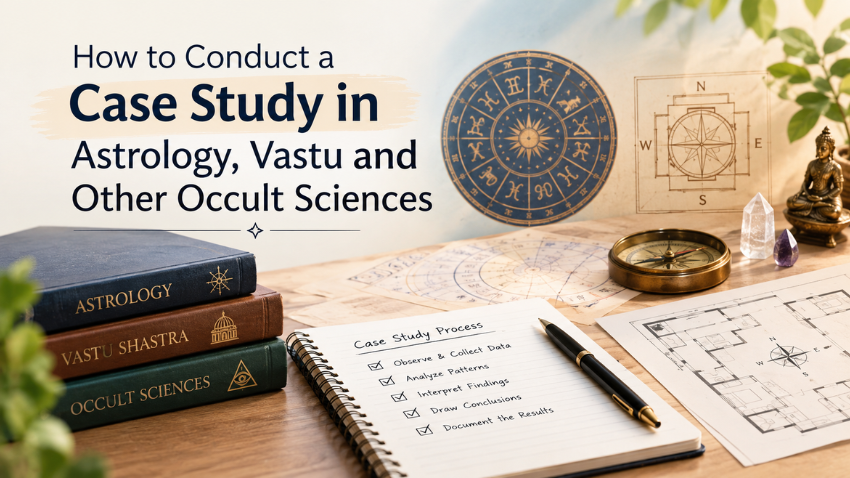
Astrology, Vastu Shastra and other occult sciences involve the study of traditional systems, patterns and interpretations that have been followed for generations. A case study is a useful way to understand how these principles are applied to specific situations. Instead of studying concepts only in theory, students and practitioners can examine real-life cases, document observations and understand different methods of interpretation.
What Is a Case Study in Occult Sciences?
A case study is a detailed examination of a particular person, place, event or situation using the principles of a specific occult discipline. In astrology, a case may involve studying a birth chart and comparing planetary positions with important life events. In Vastu Shastra, the study may focus on the layout, direction, entrance, rooms and energy-related principles of a property.
The objective should be to document the process clearly rather than simply reach a predetermined conclusion.
Step 1: Identify the Objective of the Case Study
Start by determining the specific topic or question you want to explore. A case study could focus on career-related astrology, marriage and relationships, education, business, health-related traditional interpretations, property planning or Vastu principles.
A clearly defined objective makes it easier to collect relevant information and avoid unnecessary details.
Step 2: Collect Relevant Information
Accurate information is important for meaningful documentation. For an astrology case study, this may include the person’s date, time and place of birth, along with significant events and their dates.
For a Vastu case study, collect details such as the property’s location, floor plan, directions, entrance position, room placement and purpose of different spaces.
Always obtain appropriate consent before recording or publishing personal information.
Step 3: Apply the Relevant Principles
Once the information has been collected, identify the traditional principles that apply to the case. In astrology, this could involve examining planetary positions, houses, aspects, signs, dashas or other relevant techniques.
In Vastu, the analysis may include directions, zoning, entrances, room locations, proportions and other traditional guidelines.
The methodology should be clearly documented so another student or practitioner can understand how the interpretation was developed.
Step 4: Record Observations
Keep the observations separate from assumptions. Note what the chart, property or other subject actually shows according to the selected system. Then document the traditional interpretation associated with those observations.
Maintaining this distinction makes the case study more organized and helps reduce personal bias.
Step 5: Compare With Known Events
Where appropriate, compare the analysis with documented events or information provided by the individual. For example, an astrology case study can compare major life events with the relevant periods or planetary combinations being studied.
Similarly, a Vastu case study can examine the property’s characteristics alongside the traditional Vastu principles being evaluated.
This comparison should be presented carefully without making unsupported claims of certainty.
Step 6: Document the Findings
A well-planned case study should have a clear structure. Start with the background, followed by the objective, information collected, methodology, observations, interpretation and findings.
Mention the limitations of the study as well. A single case cannot establish that a particular traditional principle will produce the same result in every situation.
Step 7: Maintain Ethical Standards
Ethics are important when working with personal information. Avoid revealing names, addresses, birth details or other identifying information without permission. When publishing a case study for educational purposes, anonymize sensitive information whenever possible.
Students should also distinguish traditional interpretations from scientifically established evidence and avoid presenting spiritual or occult interpretations as guaranteed outcomes.
Conclusion
Conducting case studies in Astrology, Vastu and other occult sciences is a valuable way to move beyond theoretical learning and develop a deeper understanding of traditional practices. By carefully collecting information, following a structured methodology, documenting observations and considering the limitations of each case, students can build stronger analytical and research skills.
For those who wish to explore these subjects through structured education and practical learning, Navgraha Astrology and Vastu Gurukula offers an opportunity to learn traditional concepts in greater depth. Students interested in areas such as Vastu Shastra in Bangalore can also explore specialized learning options, while those looking to pursue broader studies may consider Occult Science Courses in Bangalore to develop their knowledge across different disciplines.