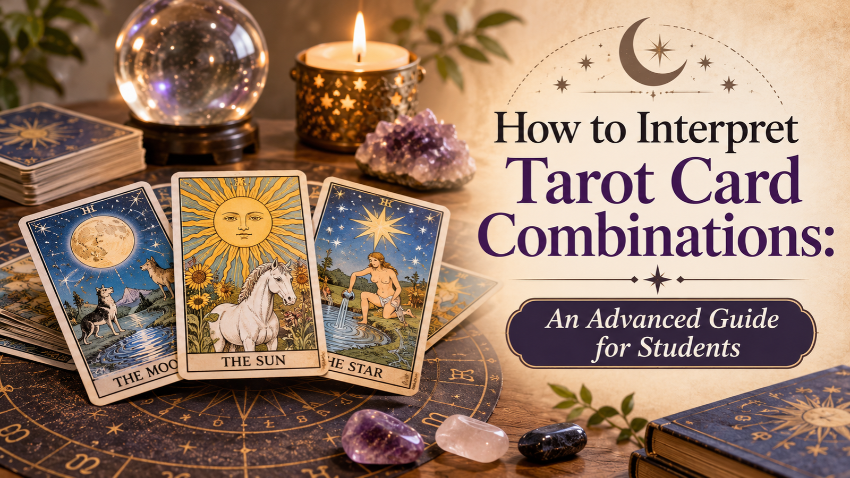
Tarot reading is more than understanding the individual meanings of 78 cards. The real skill lies in interpreting how different cards connect and influence one another during a reading. Tarot card combinations help readers understand situations from multiple perspectives and develop deeper interpretations.
For students who already understand basic tarot meanings, learning advanced tarot card interpretation techniques can improve their confidence and reading skills. By studying card relationships, symbolism, elements and patterns, students can learn to interpret complete messages rather than relying on individual card definitions.
1. Understand the Relationship Between Cards
When two or more tarot cards appear together, their meanings may complement, strengthen or challenge one another. Instead of interpreting each card separately, focus on the relationship between them.
For example, The Sun represents positivity, happiness and success, while The Tower represents sudden changes and unexpected situations. When these cards appear together, they may suggest positive opportunities emerging after a period of disruption.
Understanding these connections is an important part of advanced tarot reading.
2. Identify Major and Minor Arcana Combinations
Not every tarot combination carries a straightforward message. Some cards reinforce positive themes, while others highlight difficulties or conflicting situations.
For example:
The Star + The Sun: This combination may represent hope, confidence, positivity and renewed motivation.
The Tower + Ten of Swords: This pairing may indicate disruption, difficult endings or the need to accept major changes.
The Magician + Ace of Pentacles: This combination may suggest using skills and available opportunities to begin a practical project.
Remember that tarot interpretations depend on the question, card positions and surrounding cards. These examples are possible interpretations rather than fixed predictions.
5. Consider Card Positions and Reversed Cards
The position of each card can change the overall meaning of a tarot spread. In a three-card reading, the cards may represent the past, present and future, or situation, challenge and advice.
For example, a positive card in the challenge position may suggest that success is possible but requires confidence or personal effort.
Reversed cards also add another layer of interpretation. Depending on the reading tradition and context, they may indicate delays, internal struggles, blocked energy or an imbalance in the card’s usual qualities.
Students should avoid applying the same reversed meaning to every situation.
6. Practise Interpreting Tarot Combinations
Consistent practice is essential for developing advanced tarot reading skills. Students can begin with two-card combinations before moving towards three-card and larger spreads.
Maintain a tarot journal and record the cards drawn, their individual meanings, possible connections and the final interpretation.
Over time, compare your interpretations with real-life situations and reflect on how different card relationships influence the reading. This exercise helps develop an independent reading style instead of depending entirely on memorised meanings.
Conclusion
Mastering tarot card combinations requires patience, observation and regular practice. By understanding card relationships, elemental connections, symbolism, reversed cards and spread positions, students can develop a deeper approach to tarot interpretation.
If you are interested in exploring tarot techniques and developing your knowledge further, visit Navgraha Astro Vastu Gurukula. Those looking for Tarot Reading in Bangalore or opportunities to Learn Tarot Reading in Bangalore can explore the available learning resources and take the next step towards understanding the art of tarot reading.