Gemstones have an important place in Vedic astrology, where each precious stone is traditionally associated with a particular planet. According to Vedic astrological principles, the nine planets, also known as Navagrahas, represent different influences in a person’s horoscope. Understanding the connection between planets and gemstones is an interesting part of learning astrology.
For students who want to explore this subject, studying planetary gemstone associations provides a foundation for understanding traditional astrological practices, planetary positions, and gemstone recommendations.
Understanding the Nine Planetary Gemstones
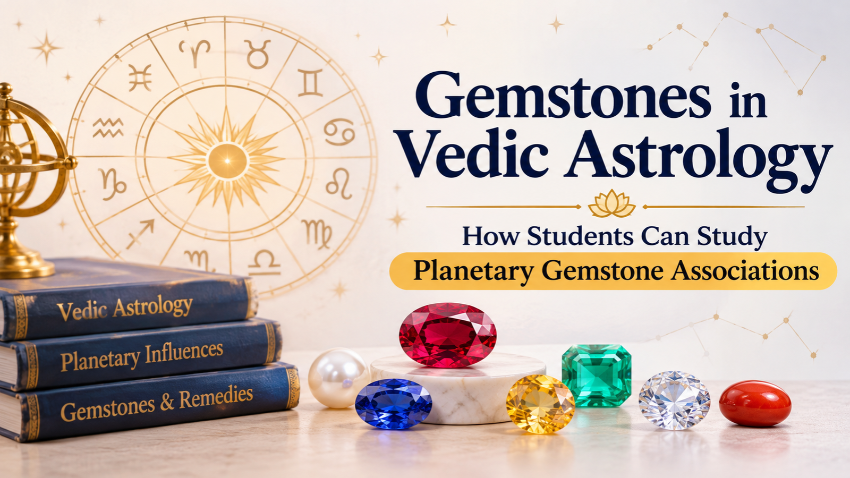
In Vedic astrology, nine primary gemstones are associated with the Navagrahas. Each gemstone represents a specific planet and has its own traditional significance.
The nine planetary gemstones include:
- Sun (Surya) – Ruby: Traditionally associated with confidence, leadership, authority, and vitality.
- Moon (Chandra) – Pearl: Connected with emotional balance, peace, and mental well-being.
- Mars (Mangal) – Red Coral: Traditionally represents courage, energy, determination, and strength.
- Mercury (Budh) – Emerald: Associated with communication, intelligence, learning, and business skills.
- Jupiter (Guru) – Yellow Sapphire: Represents wisdom, knowledge, prosperity, and spiritual growth.
- Venus (Shukra) – Diamond: Traditionally connected with beauty, creativity, relationships, and luxury.
- Saturn (Shani) – Blue Sapphire: Associated with discipline, responsibility, patience, and hard work.
- Rahu – Hessonite: Traditionally linked with ambition, material desires, and unconventional thinking.
- Ketu – Cat’s Eye: Associated with spirituality, intuition, detachment, and self-discovery.
These associations form the basis of understanding Navratna gemstones and their traditional role in Vedic astrology.
How Students Can Study Planetary Gemstone Associations
Learning gemstone astrology requires more than memorising the names of planets and their corresponding stones. Students should develop a systematic understanding of astrological concepts.
1. Learn About the Navagrahas
Begin by understanding the nine planets, their characteristics, significance, and roles in a birth chart. Learning their natural relationships and traditional astrological qualities helps students understand why specific gemstones are associated with them.
2. Understand the Basics of a Horoscope
Students should learn how to read a birth chart, identify planetary placements, and understand the twelve houses and zodiac signs. This knowledge provides the foundation for studying gemstone recommendations.
3. Study Each Gemstone Individually
Explore the traditional properties, colours, characteristics, and planetary associations of all nine gemstones. Students can also learn about gemstone quality, authenticity, clarity, and common varieties.
4. Understand Planetary Strength and Placement
In Vedic astrology, gemstone recommendations are traditionally based on horoscope analysis rather than zodiac signs alone. Students should understand planetary strength, dignity, house ownership, aspects, and the overall chart before studying how gemstones are prescribed.
5. Explore Traditional Astrology Texts
Reading authentic Vedic astrology references and learning from experienced teachers can help students develop a deeper understanding of gemstone principles. Practical chart analysis also helps connect theoretical knowledge with traditional applications.
Importance of Learning Gemstone Astrology
Studying gemstones in Vedic astrology helps students explore the relationship between planetary symbolism and traditional astrological remedies. It also introduces them to the cultural and historical significance of precious stones in Indian astrology.
Students can develop knowledge of Navratna gemstones, their classifications, traditional uses, and the principles followed while evaluating gemstone suitability. It is important to approach this subject with proper guidance rather than making recommendations based only on general zodiac descriptions.
Gemstone astrology is a traditional belief system, and its claimed effects are not scientifically established. Therefore, students should understand the subject as part of their astrological education.
Conclusion
Understanding planetary gemstone associations is an essential area of study for students interested in Vedic astrology. From learning about the Navagrahas to understanding horoscope analysis and traditional gemstone selection, each step builds a stronger foundation in this subject.
For students interested in exploring Gemstone Astrology in Bangalore, choosing the right learning environment can make a difference. Navgraha Astrology and Vastu Gurukula provides an opportunity to explore traditional astrological knowledge and deepen your understanding of related subjects. If you are looking for a Vedic Astrology Institute in Bangalore, learning through structured guidance can help you build a strong foundation in Vedic astrology and its traditional practices.